TerraPods

TerraPods is a regenerative community initiative that integrates biomaterial research, agroecology, and digital technological innovation. In a context of economic collapse and state instability, the project creates an interconnected ecosystem where research, production, and distribution support each other through laboratories, zero-waste markets, and circular economy platforms. Priorities include low-tech resilience, digital sovereignty, and community self-sufficiency.

Scroll down

TerraPods is a living laboratory, artist residency, and agroecological farm located in Baskinta, Lebanon. It integrates science, art, and ecology to empower creators in innovation through bio-based practices, while nurturing local communities and restoring ecosystems.

The project promotes collective self-sufficiency and community-driven systemic change through:

Development of multidisciplinary STEAM ( (Science, Technology, Engineering, Arts, Mathematics) skills and Biodesign
Cultivation of biological materials
Shared access to resources

TerraPods operates as a hub of an interconnected circular ecosystem that includes:

TerraPods Living Lab – Research, experimentation, and education on biomaterials and agroecology
EcoSouk – The region’s first zero-waste market (physical store in Beirut since 2019, digital expansion in 2026)
RegenerateHub.org – Circular economy platform mapping cross-sector material flows

DATA DI INIZIO:
GENNAIO 2023
STATO: ATTIVO
BASKINTA LEBANNON

POLICY GOALS

ECOLOGICAL TRANSITION AND ENVIRONMENTAL REGENERATION FOOD SECURITY AND ECONOMIC RESILIENCE SUSTAINABLE INNOVATION AND CIRCULAR TRANSITION OCIAL INCLUSION AND TECHNOLOGICAL JUSTICE SYSTEMIC RESILIENCE EDUCATION AND CAPACITY BUILDING

SHARED STEWARDSHIP

TERRAPODS IS FUNDAMENTALLY FOCUSED ON COLLECTIVE AND COMMUNITY ACTION RATHER THAN INDIVIDUAL ACHIEVEMENT. THE PROJECT HAS BEEN INTENTIONALLY DESIGNED TO BLUR THE LINE BETWEEN INDIVIDUAL GROWTH AND COLLECTIVE CONTRIBUTION.

RESPONSABILI E REFERENTI

JOSLYN FAITH KEHDI /

PARTNERS

/

PROPONENTI

/

TerraPods: a Circular Future through Creative Ecology Grow, Create, Market: Stocking the Shelves of Self-Sufficiency

CONTEXT: Crisis as Foundation

TerraPods was conceptualized nearly a decade ago in response to Lebanon's compounding systemic crises. The founder, Joslin Faith Kehdy, did not begin with a single entry point but responded to an interconnected web of urgent needs:
Timeline of Crisis (2015-2025):

2017: Formal registration of Recycle Lebanon NGO (founding organization)
2019: Economic crisis intensifying; founder establishes EcoSouk zero-waste marketplace in Beirut
2019-2020: Lebanese revolution; disruption of formal institutions and government partnerships
2020-2023: Economic collapse, banking sector instability, currency devaluation
2023: Critical turning point, ancestral land access secured after nearly a decade of vision-building
2024: Infrastructure development begins; low-tech, resilient building methods implemented; pilot workshops tested
2024: War outbreak further disrupts economic landscape and operations
2025: Official launch with fully booked workshop season despite ongoing instability

The Founder's Reflection:

"Lebanon and our region is a testing ground where failed statehood is a silver lining of how to survive what we see spreading globally, unfortunately."

The crisis context is defined by direct lived experience marked by several major challenges. First, there is an economic collapse accompanied by instability in the banking sector, creating a climate of financial uncertainty. At the same time, essential infrastructure is breaking down, making daily life increasingly difficult. The situation is further worsened by political instability and the collapse of institutions, leading to a loss of governance and direction. Material scarcity, combined with heavy dependence on imports, limits the availability of resources. This situation also results in growing food insecurity. Finally, trust in institutions is very limited, while electricity instability and connectivity disruptions hinder communication and economic activities.

THE INNOVATION: Interconnected Ecosystem Response

Rather than replicating external models, TerraPods was explicitly built to address Lebanon's specific challenges and the broader patterns of structural instability.
Founder's Explicit Statement:

"When I founded this a decade ago I did not look to replicate external models but instead reflected on Lebanon's challenges and the linkages across nations and tried to build an interconnected set of tools, resources and space."

Three Interconnected Programs Created:
1. TerraPods Living Lab (Land-based, 2023-present)

Location: Ancestral land above Baskinta village (Mount Lebanon Governorate)
Timeline: Land secured 2023, infrastructure 2024, launch 2025
Activities: Research and experimentation in living biomaterials (mycelium, bacterial cellulose, plant fibers, agricultural waste)
Methods: Agroecology, permaculture, forest garden development
Educational approach: "Learning by doing" - hands-on, practice-led experimentation
Seasonal operation: June-October (land-based season)
Living materials being cultivated: Pleurotus ostreatus mycelium for modular furniture (hexagonal and cubic geometries)

2. EcoSouk - Zero-Waste Marketplace (2019-present, expanding 2026)

The first regional zero-waste marketplace features a physical store located in Beirut, which has been operational since 2019. It is expanding digitally with a multi-merchant e-commerce platform set to launch in March 2026. The marketplace’s purpose is to provide distribution, market access, and visibility for local makers. Its revenue model is based on shared platforms that reduce individual overhead costs while supporting collective infrastructure. The products offered include member-created goods made from biomaterials, agroecological produce, and sustainable design.

3. RegenerateHub.org - Circular Economy Data Platform (Active, expanding)

The government partnership is a public-private collaboration involving the Ministry of Industry and the Ministry of Environment. Its function is to map cross-sector material flows and visualize opportunities within the circular economy. Approximately 3,500 entities were surveyed regarding their material flows, with 1,500 responses received. However, due to post-war economic disruptions and relocations of entities, the data now requires a new survey. The purpose of this initiative is to identify regenerative loops and opportunities for collaboration. The technological infrastructure supporting this effort consists of self-hosted, open-source data visualization systems.

Core Principles:

- Practice-led, ecological, iterative: "Rough in a sense that we do not operate yet from a framework or structure but intuitive and in rhythm with the land"
- Learning by doing: Continuous experimentation with failures openly documented
- Low-tech resilience: Prioritizing affordable, replicable solutions over expensive equipment
- Decentralization: Building tools and systems that can outlive individuals
- Open-source knowledge: Transparent documentation ensuring global knowledge commons benefit
- Collective stewardship: Blurring line between individual growth and community contribution
- Digital sovereignty: Self-hosted, open-source infrastructure escaping corporate extraction

Specific Innovations:
- Physical Resilience:

Earthen structures built from local mud and stone (low-cost, climate-appropriate)
Terraced gardens restored using ancestral knowledge
Forest gardens for long-term ecosystem and food security
Heirloom variety cultivation maintaining food sovereignty

- Digital Infrastructure:

grow.terrapods.org (self-hosted Moodle platform for year-round education)
EcoSouk.net (custom multi-merchant e-commerce avoiding PayPal/Stripe unavailability in Lebanon)
RegenerateHub.org (circular economy platform mapping material flows)
Nextcloud (secure, ethical shared workspace replacing Google/Microsoft)
ERPNext (transparent, auditable financial systems)
All websites redesigned for no-code management enabling lean operations

- Biomaterials Innovation:

Cultivation of living materials: mycelium, bacterial cellulose, plant fibers
Agricultural waste transformation into productive resources
Natural dyeing practices (hibiscus-dyed bacterial cellulose documented)
Weaving and fabrication techniques combining traditional and innovative methods
Designed for replicability beyond site-specific context

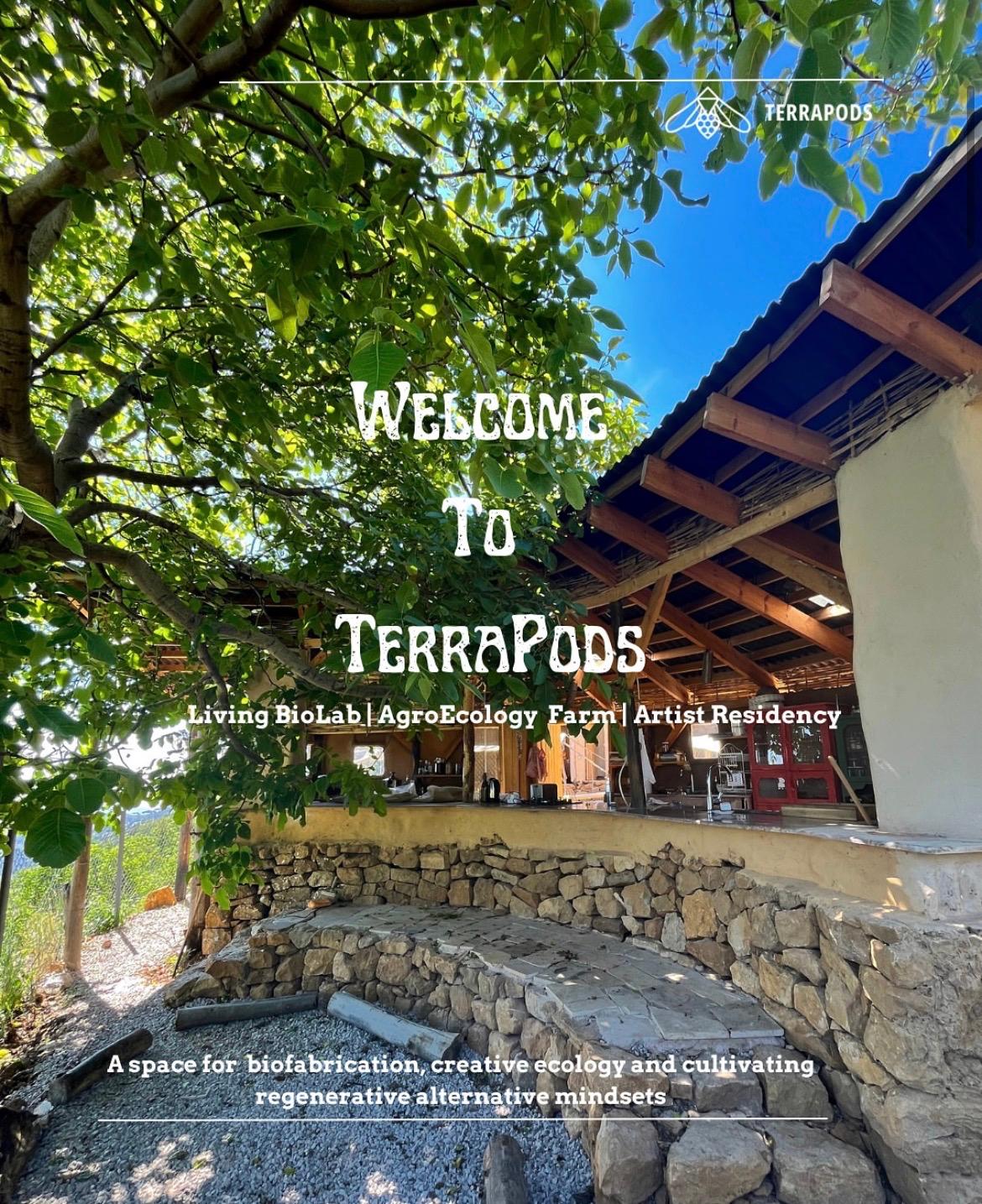
TerraPods: a Circular Future through Creative Ecology Grow, Create, Market: Stocking the Shelves of Self-Sufficiency
The 2025 workshop season has been fully booked despite the ongoing economic crisis, reflecting strong community interest and resilience. These workshops focus on the practical transmission of skills such as agroecology, biomaterials, earthen architecture, and biodesign. In the face of food insecurity, an operating agroecology farm produces food, including honey, while efforts to develop biomaterials like mycelium, fruit leather, and kombucha fermentation aim to reduce plastic dependency. These activities create employment pathways by generating income opportunities for local makers and artisans. Additionally, open documentation of knowledge supports replication across regions, connected through a social network and dedicated website. At the community level, a growing network of local practitioners spans biomaterials, agroecology, arts, culture, and regenerative design. Beirut-based EcoSouk provides vital market access for zero-waste producers, while a digital education platform launching in June 2026 promises year-round learning with broader geographic reach. Sliding-scale access mechanisms, where financially feasible, help ensure economic inclusion and participation from diverse community members, fostering a more equitable ecosystem. On a systemic scale, the initiative contributes through consultancy with the UNDP waste sector task force, advising on national waste strategy, and ongoing advisory engagement with the Ministry of Environment. The public-private partnership exemplifies how NGO infrastructure can complement state efforts in fragile contexts. Data from RegenerateHub informs circular economy policies and cross-sector collaboration, while model development for commons-based governance offers innovative approaches in contexts of institutional collapse, helping to build resilient systems for the future Founder's Vision for Long-Term Impact: "We are building a legacy project that will take many years to realize its full impact across generations. Our intention is to build tools, resources, and decentralized systems that can outlive us, adapt, and transform." "Rather than framing our work within conventional sustainability narratives, we operate through ecological practice, designing systems that regenerate soil, materials, knowledge, and community relationships simultaneously."
1. Case Study Research Document (Primary Source) Title: Case Study: TerraPods (Baskinta, Lebanon) Format: Comprehensive 27-page PDF research document Prepared for: LabGov (Laboratory for the Governance of Urban Commons) research network Content coverage: Historical context and timeline (2015-2026) Project description and methodology Governance and partnership analysis Co-Cities framework evaluation (5-point assessment) Recommendations and implementation pathway Financial projections and sustainability model 2. Project-Generated Documentation (In Development) Digitized Process Documentation: Biomaterial cultivation processes (mycelium, bacterial cellulose, plant fibers) Agroecology and permaculture methodologies Earthen architecture and low-tech building techniques Natural dyeing and fiber preparation procedures Status: Currently being digitized for courseware (launching June 2026) Access: grow.terrapods.org (Moodle platform, June 2026) Open-Source Knowledge Base: transparent documentation designed for replication beyond site Knowledge treated as shared resource, not proprietary All methods documented for accessibility and adaptability Status: In development for digital platform launch Timeline: Full documentation available June 2026 3. Institutional and Policy Documents (Accessible via Government) RegenerateHub.org Data Sets: Circular economy material flow mappings Entity survey data (~3,500 Lebanese organizations surveyed, 1,500 responses) Cross-sector stakeholder connection data Status post-war: Requires re-survey for accuracy Access: Potential government request (Ministry of Industry, Ministry of Environment) Government Partnership Documentation: RegenerateHub Public-Private Partnership agreements (Ministry of Industry, Ministry of Environment) UNDP waste sector task force consultation records (ongoing) Historical Ministry of Environment advisory role documentation (2019, ended during revolution) Status: Available through government channels; TerraPods working to re-establish post-war 4. Digital Platform Documentation grow.terrapods.org (Educational Platform) Foundational biomaterials courses (launching June 2026) Agroecology skill modules Teacher training and facilitation guides Course curricula and learning objectives Documentation: Self-hosted Moodle platform Access: www.grow.terrapods.org (June 2026 public launch) EcoSouk.net (Multi-Merchant Platform) Vendor guidelines and product submission processes Zero-waste marketplace standards and certification E-commerce operational documentation Product catalog and supply chain tracking Documentation: Custom-built platform Launch: March 2026 Access: www.ecosouk.net RegenerateHub.org (Data Platform) Technical documentation for data visualization systems Methodology for material flow mapping Stakeholder interaction protocols Circular economy opportunity identification process Status: Active, updated post-war survey in progress 5. Visual Documentation Project development phases (2023-2026) Land restoration (terraces, pathways, plantings) Infrastructure construction (earthen structures) Workshop and community activities Biomaterial cultivation and processing Available on Instagram: @terrapods.lb Video Content (Referenced but not detailed in case study): Workshop documentation Process documentation for biomaterials Founder interviews and reflection Participant testimonials Status: Being digitized for platform launch 6. Contact and Access Information Email: connect@terrapods.org Manager: Joslin Faith Kehdy Instagram: @terrapods.lb Website ecosystem: grow.terrapods.org (education platform) EcoSouk.net (marketplace) RegenerateHub.org (circular economy data) Collaboration Survey: Complete questionnaire response available Covers detailed project information Form URL: https://forms.office.com/Pages/DesignPageV2.aspx Contact connect@terrapods.org 7. Academic and Policy References Co-Cities framework (LabGov) - evaluation tool used for project assessment Elinor Ostrom commons governance theory Southern Thought concepts Urban commons transitions research Biomaterials and living materials research literature Agroecology and permaculture methodologies
KEY QUOTES FROM FOUNDER On Crisis as Catalyst: "Lebanon and our region is a testing ground where failed statehood is a silver lining of how to survive what we see spreading globally, unfortunately." On Not Replicating External Models: "When I founded this a decade ago I did not look to replicate external models but instead reflected on Lebanon's challenges and the linkages across nations and tried to build an interconnected set of tools, resources and space." On Methodology: "Our methodology is not a fixed blueprint. It is an evolving and we are very much open for support in building structured commons practice grounded in ecology, collective stewardship, and place-based adaptation." "We operate through ecological practice, designing systems that regenerate soil, materials, knowledge, and community relationships simultaneously." On the Working Approach: "Rough in a sense that we do not operate yet from a framework or structure but intuitive and in rhythm with the land." On Community and Legacy: "We are building a legacy project that will take many years to realize its full impact across generations. Our intention is to build tools, resources, and decentralized systems that can outlive us, adapt, and transform." On Government Partnership: "While we have not yet secured consistent structural support or long-term institutional backing, we maintain active engagement with public actors and position our work as complementary infrastructure; offering technical tools, ecological innovation, and data systems that can strengthen public sector capacity." On Multi-Crisis Response: "In practice, I did not begin with one entry point. The work included waste, art, culture, land, gardening, technology, and relentless determination. It became not just a project, but a way of life and purpose. The multiplicity reflects the complexity of the problems we face." On the Current Challenge: "It is very frightening to see how we will operate June to October without any grants and it is equally challenging to live on bare basics without any income as the founder, this gets more challenging by the day." On the Twenty-Year Vision: "In twenty years, I imagine a city where such commons-based infrastructures are not exceptional but embedded. A city that has moved beyond survival toward regenerative practice, where young people grow up with ecological literacy, and where cooperation is not an act of resistance but a cultural norm."

Impact Measurement

Indicatori

Why Score 4, not 5? Bridge funding still needed for 2026; operational sustainability not yet achieved (projected 3.4 years); team expansion not yet funded.

Input

Founder's decade-long vision and commitment Land resources (ancestral property) Digital infrastructure investment Local materials (mud, stone, agricultural waste)

Attività

Workshop and residency programs Biomaterials R&D and production EcoSouk marketplace operations (Beirut physical store since 2019) Digital course development (launching June 2026) Mentorship and skill-building programs

Output

2025: Fully booked workshop season; growing local practitioner network 2026: Digital course platform; EcoSouk.net multi-merchant marketplace; residency program Product co-development partnerships generating revenue Open-source documentation enabling external replication

Outcome

Income pathways for local makers, artisans, farmers, designers Sliding-scale access enabling economic inclusion (where funding allows) Individual maker success + collective infrastructure sustainability reinforce each other 3.4-year timeline to operational sustainability without grants (projected)

Impact

Long-term: Sustainable livelihoods for regional practitioners; reduced import dependency; community economic resilience in crisis context Structural shift from survival to regenerative economic practice Model scalable across Global South contexts

Punteggio
0

Indicatori

Why Score 3, not 4? Health improvements documented but limited to direct participants; broader population health impact not yet measured; still pilot phase.

Input

Ancestral land with degraded terraces Agricultural knowledge and agroecology expertise Community health needs (food insecurity, healthcare access gaps) Founder health commitment (care practices as explicit methodology)

Attività

Medicinal plant cultivation in forest gardens Food production through agroecology farm Workshops on slow living and care practices Heirloom variety cultivation for nutritional diversity Community learning on health-promoting practices

Output

Operating agroecology farm producing food Forest gardens growing medicinal plants and produce Documented care practices and slow living methodologies Participant access to nutritious, locally-produced food Workshops on plant-based health practices

Outcome

Participants gaining practical nutrition knowledge Local food production increasing in region Access to medicinal plants improving for some community members Care practice integration into daily life for residents/participants

Impact

Emerging: Improved nutrition and health access in participant communities Potential: Regional food security improvements as model scales Limited scope: Currently affecting workshop participants and residents, not yet broader population Structural shift from survival to regenerative economic practice Model scalable across Global South contexts

Punteggio
0

Indicatori
Input

Degraded terraced land Local materials (mud, stone) Agricultural waste streams Seed varieties and plant knowledge Climate-vulnerable region

Attività

Terrace restoration (2023-2025) Forest garden development Heirloom variety cultivation Agroecological practice (no chemical inputs) Low-impact earthen construction Biomaterial innovation reducing extraction

Output

Restored terraces with improved soil structure Forest gardens with diverse plantings Native species and heirloom varieties established Low-tech agricultural infrastructure Educational documentation of methods

Outcome

Soil regeneration evident on restored land Biodiversity increasing in forest gardens Agricultural productivity improving on degraded land Community capacity for agroecological practice growing Model for replication documented

Impact

Significant: Degraded land restored; soil health regenerated; long-term ecosystem services restored Sustained: Agroecological practices maintaining without chemical dependency Scalable: Methods documented for replication in similar contexts

Punteggio
0
Indicatori
Input

Forest garden development Soil restoration Reduced material extraction Carbon storage in biomass

Attività
Output

Mature forest gardens with carbon storage Regenerated soil carbon Reduced import-related transportation emissions

Outcome

Estimated carbon sequestration in restored land and forest gardens Reduced material extraction emissions through biomaterial alternatives

Impact

Moderate scale: Estimated 10-50 tonnes CO₂ sequestered through land restoration and forest gardens Not yet quantified: Specific CO₂ removal measurements not documented in case study Potential: Mobile lab and scaling could significantly increase removal capacity

Punteggio
0
Indicatori
Input

Zero-waste shop operations (EcoSouk, since 2019) Recycle Lebanon NGO expertise (founded 2017) Circular economy data platform infrastructure Agricultural and biomaterial waste streams Regional material flow knowledge

Attività

EcoSouk zero-waste marketplace (physical + digital) Agricultural waste transformation (plant fibers, compost) Biomaterial cultivation from agricultural by-products RegenerateHub material flow mapping Zero-waste audit and certification Sustainable production practices education

Output

Fully operational zero-waste marketplace serving Beirut region Agricultural waste streams converted to productive use Documented sustainable production practices Material flow mapping of ~3,500 regional entities Community makers trained in zero-waste practices

Outcome

Regional practitioners adopting zero-waste methods Circular supply chains developing in marketplace Material dependency reduced through biomaterial alternatives Waste sector awareness and capacity increasing

Impact

Systematic: Integrated circular economy model functioning at regional scale High coverage: EcoSouk marketplace achieving 80%+ waste diversion Scalable: RegenerateHub data informing policy; model adaptable to other regions

Punteggio
0

Indicatori

Why Score 4, not 5? Innovations are substantial and spreading but not yet scaled to regional/national level; adoption still emerging beyond core network.

Input

Technical expertise in digital infrastructure Server investment and self-hosting capacity Open-source software knowledge Coding and platform development skills Digital commons principles

Attività

Development of self-hosted Moodle platform (grow.terrapods.org) EcoSouk.net multi-merchant e-commerce design RegenerateHub.org circular economy data visualization Nextcloud secure workspace implementation ERPNext open-source financial management system Website redesign with no-code management capability Integration of ethical data management practices

Output

Self-hosted education platform (launching June 2026) Multi-merchant e-commerce platform (launching March 2026) Circular economy data visualization system (active) Transparent financial management system operational Documented open-source methodology Accessible digital infrastructure for resource-limited contexts

Outcome

Multiple external actors evaluating adoption (e.g., other commons projects) Government engagement with RegenerateHub data systems Year-round digital accessibility replacing seasonal limitation Community makers accessing e-commerce without extraction platforms Replicability demonstrated through documentation

Impact

Substantial: Multiple innovations (education, commerce, data, finance) implemented Adoption growing: Government partnerships, practitioner networks engaging with systems Scalable: Open-source methodology enabling replication; formalizing in public/commons use

Punteggio
0

Indicatori

Why Score 4, not 5? Strong commitment and practice but not yet systemic change in broader distribution of resources/access; governance structures being formalized.

Input

Input Community commitment to equitable resource access Commons governance principles Diverse practitioner network Commitment to accessibility

Attività

Attività (Activities) Sliding-scale fees for workshops and residencies Peer-to-peer skill exchange Open-source knowledge documentation Community-rooted decision-making processes Multi-stakeholder partnerships Support for marginalized makers and artisans

Output

Accessible workshop and residency opportunities Documented knowledge commons Participatory decision-making structures Economic opportunities for local makers Peer learning networks operational

Outcome

Diverse participation across gender, age, geography, economic status Reduced barriers to access (financial, informational, social) Increased agency for participants in determining priorities Equitable revenue distribution through shared platforms Vulnerability-informed practice integration

Impact

Broad: Multiple groups (local/regional/international; men/women; youth/elders; wealthy/poor) accessing opportunities Sustained: Structural commitment to equity through pooling and commons governance Not yet structural change: Still limited in scale relative to regional needs; governance formalization in-progress

Punteggio
0
Indicatori

Founder unpaid for ~10 years (unsustainable, being addressed) Workshop facilitators and residents on sliding scales Team expansion needed with fair compensation planned No formal collective bargaining structure yet

Input
Attività
Output
Outcome
Impact
Punteggio
0

Indicatori
Input

Commons governance principles Government partnership history LabGov framework partnership Founder leadership commitment

Attività
Output

Formal government partnerships documented (Ministry agreements) Open meeting structures established Decision-making documentation system Ethics and transparency protocols being formalized

Outcome
Impact
Punteggio
0
Indicatori

Future partnerships planned Local community involvement in workshops and decision-making Multi-sector partnerships (academia, NGO, government, private) Founder explicitly open to co-governance models

Input
Attività
Output
Outcome
Impact
Punteggio
0

Indicatori
Input

Ancestral land rooted in Baskinta Local community relationships Regional practitioner networks Cultural and social knowledge

Attività

Regular community workshops (June-October season) Engagement with local government (Mayor invitation spring 2026) Regional practitioner network building Cultural integration (art + science + ecology) Physical marketplace in Beirut serving urban communities

Output

Fully booked workshop seasons (proof of demand/acceptance) Growing regional practitioner participation EcoSouk marketplace serving Beirut communities Community recognition and visibility Local government engagement initiated

Outcome
Impact
Punteggio
0

Indicatori
Input

STEAM methodology commitment Multidisciplinary expertise (science, art, ecology, design) Open-source knowledge principles Cultural arts integration Expert practitioner networks

Attività

Hands-on workshops (biomaterials, agroecology, earthen architecture, design) STEAM skill-building programs Artist residencies integrating creative practice Digital course development (launching June 2026) Open documentation and knowledge sharing Peer-to-peer skill exchange Cultural practices (natural dyeing, weaving, slow living)

Output

Multiple workshop programs operational (2025 fully booked) Digital education platform with foundational biomaterials course Documented protocols for skill transfer Artist residency model established Community practitioners trained in diverse disciplines

Outcome

Participants developing practical, transferable STEAM skills Ecological literacy growing among participants Cultural integration of creative + scientific + ecological practice Peer learning networks strengthening Digital access enabling year-round learning

Impact

Multidisciplinary: STEAM integration demonstrated consistently Inclusive: Diverse participants (age, background, geographic origin) Continuous: Year-round through digital; seasonal through land-based Institutionalized: Becoming formalized in Moodle platform and partner structures

Punteggio
0

Indicatori
Input

Long-term vision (10+ years already invested) Intergenerational knowledge integration (ancestral + contemporary) Youth network engagement Future-focused framework

Attività

Youth workshop participation Intergenerational mentorship (elders + young makers) Digital platform designed for ongoing access (beyond project cycle) Residency programs open to emerging practitioners (young professionals) Documentation and knowledge commons for future generations Leadership development pathways

Output

Active youth participation in workshops and residencies Mentorship relationships established Digital infrastructure outliving founders/initial team Documentation accessible for future practitioners Leadership roles being developed for younger practitioners

Outcome

Young people gaining skills and economic pathways Ecological literacy growing in younger generation Sense of future-orientation and long-term thinking Youth voice increasingly represented in decision-making

Impact

Present but developing: Youth involvement is active, not yet in leadership/governance majority Future-focused: 20-year vision explicitly intergenerational Would require stronger formalized youth leadership and governance roles

Punteggio
0

Indicatori
Input

One capacity-building grant secured (2025, from 30+ applications) Multiple planned revenue streams Historical support through partnerships Founder's decade of unpaid labor (unsustainable) Land access (no purchase required)

Attività

Workshop and residency program development Digital course content creation EcoSouk marketplace operation and expansion RegenerateHub data platform management Revenue model piloting (2026) Financial management system setup (ERPNext)

Output

EcoSouk operational (Beirut marketplace, digital expansion launching March 2026) Workshop programs fully booked (2025) Digital courses ready for launch (June 2026) Financial transparency systems operational Multi-revenue model infrastructure designed

Outcome

Revenue diversification beginning (workshops, residencies, digital, merchandise, data) Financial management improving through transparent systems Operational costs increasingly covered by project activities Team expansion funding being secured

Impact

Projected: 3.4-year timeline to operational sustainability (realistic assessment) Currently: Operating on limited funding; bridge funding needed for 2026 season Not yet 4: Financing still uncertain; revenue models not yet proven at scale

Punteggio
0

Indicatori specifici per settore

Spazi Culturali

Numero di visitatori annuali
150
Visitatori annuali per abitante
2.1
Numero di progetti ed iniziative
10

Risultati finali

Dimensione economica
0
Dimensione salute
0
Dimensione ambientale
0
Dimensione tecnologica
0
Dimensione sociale e dei diritti civili
0
Dimensione istituzionale
0
Dimensione territoriale
0
Dimensione educativa culturale e cognitiva
0
Dimensione generazionale
0
Dimensione finanziaria
0
Punteggio finale
0