Spazi Culturali
1 indicatori125
CIP is a permaculture and regenerative agriculture center located in peri-urban Resistencia, Chaco province, Argentina. Founded by two brothers (one trained in commerce/business, one in agronomy/medicinal cannabis cultivation), the project demonstrates how degraded land, minimal capital, and strategic institutional partnerships can create productive regenerative systems. On 1 hectare of ancestral land 4km from the airport, CIP has planted 5,000-8,000 trees using syntrophic agroforestry principles. The project operates as an open-access learning space where community members learn agroecology, bioconstruction, seed banking, and fermentation. CIP functions as both practical demonstration site and educational hub for the region. The philosophy: "Agricultural education for people to work the earth again—to exit concrete and screens."

CIP is a permaculture and regenerative agriculture center located in peri-urban Resistencia, Chaco province, Argentina. Founded by two brothers (one trained in commerce/business, one in agronomy/medicinal cannabis cultivation), the project demonstrates how degraded land, minimal capital, and strategic institutional partnerships can create productive regenerative systems.
On 1 hectare of ancestral land 4km from the airport, CIP has planted 5,000-8,000 trees using syntrophic agroforestry principles. The project operates as an open-access learning space where community members learn agroecology, bioconstruction, seed banking, and fermentation. CIP functions as both practical demonstration site and educational hub for the region.
The philosophy: “Agricultural education for people to work the earth again—to exit concrete and screens.”
Location: Taco Pozo 4202, Resistencia, Chaco (4km airport)
Key Slogan: First Argentine Forest Labyrinth; Syntrophic agroforestry model adaptable to peri-urban Latin America
Founded November 8, 2023 (2 years operation at time of evaluation). Despite early stage, project has established multiple formal government partnerships, university collaborations, and operational infrastructure. Characterized as early but with institutional grounding unusual for emerging projects.
Timeline:
November 2023: Official launch, 1 hectare land access from uncle
2023-2024: Infrastructure development (bioconstruction, tree planting)
2024: 5,000-8,000 trees planted; pilot workshops; SAR aquaponic system development
2024: War outbreak disrupted operations, economic landscape
2025: Active season, continued expansion planning
2026: Scaling phase with team expansion and mobile lab development (planned)
Fully operational with seasonal (June-October) land-based programs and year-round planning. Multiple active partnerships. Facing challenges (climate events, team capacity, market access) but expanding structurally and geographically.
Operational Status:
Land-based season: June-October (productive)
Winter planning: November-May (organizing, designing, planning)
150-200 visitors in 2 years
Fully booked workshops (2025)
Infrastructure continuously improving
Facing: 2024 flooding (300mm destroyed portion of interior) – rebuilding
THE CONTEXT: CRISIS AS CATALYST
Two brothers from Resistencia, Chaco faced a choice at a critical moment:
Brother 1: After 12 years working in commerce in Buenos Aires, 5 years managing a retail store, he had built career and savings. But he witnessed consumption culture, disconnection from land, and systemic instability.
Brother 2: 10 years working in medicinal cannabis cultivation, established first grow shop in Chaco, brought scientific and horticultural knowledge.
Shared heritage: Both grew up fishing and hunting, connected to land through family practice.
The catalyst: Brother 1 spent 3 months in São José dos Campos, Brazil, studying Ernst Götsch's syntrophic agroforestry—a method that transforms degraded land through ecological principles rather than inputs.
He returned with a revelation: This could work in Chaco. The region has land, climate, agricultural heritage—but current economic model offers no pathway for young people to remain on land.
THE BEGINNING: NOVEMBER 8, 2023
Their uncle offered 1 hectare of ancestral land in Resistencia (4km from airport, peri-urban zone). They arrived with:
Minimal capital (personal savings)
No electricity (first year)
Inundable clay soil (major design constraint)
Extreme climate (40°C+ heat, intense cold, drought, flooding)
But: physical strength, agricultural knowledge, and determination
Their philosophy: "We'll design systems we can manage with just two people. Everything manual. Work with what we have."
THE WORK: FIVE YEARS, FIVE LAYERS
2023-2024: Foundation
Secured land access
Restored terraces and pathways
Planted heirloom varieties
Established foundational agroecology practices
Constructed first earthen structures
2024: Infrastructure & Innovation
Constructed earthen structures using local mud and stone
Built multiple bioconstruction types (COB, cob, bahareque, quincha, encofrado)
Each structure different—pedagogical demonstration of diversity
Tested pilot workshops
Developed relationships with practitioners
Disrupted operations, economic landscape shifted
2024-2025: Systemic Development
Planted 5,000-8,000 trees in syntrophic arrangement
Created 5-line forest garden systems for biodiversity and resilience
Established SAR (systemic aquaponic recirculation) system
Won ICCTI innovation project for aquaponic system
Created LECA substrate for mass plant multiplication
Started production: fermented beverages, kéfir, kombucha, smoked preserves, Greek yogurt, chucrut with oyster mushrooms
2025: Community & Institutional Integration
150-200 visitors (2 years)
Fully booked workshops
Active seed bank (continuous community exchange)
Multiple institutional partnerships active
Municipal partnership (all urban pruning waste delivered to site)
University collaboration for flagship Forest Labyrinth project
2026: Expansion Phase
Scaling production
Team expansion planning
Educational formalization
Tourism development
Market development for products
THE INNOVATION: SYNTROPHIC AGROFORESTRY
What makes CIP distinctive: applying Ernst Götsch's syntrophic agroforestry to Chaco's specific context.
Traditional approach: Monoculture, external inputs, soil degradation, economic dependency
Syntrophic approach:
Every plant serves multiple functions
Fixed nitrogen, dynamic accumulation, pioneering, productive, protective species in strategic arrangement
Biodiversity generates resilience
System becomes increasingly productive over time as biodiversity and soil health improve
Climate-adapted polyculture handles extreme weather through diversity
5-Line System:
Lines of strategically arranged plants where:
Line 1: Pioneer species opening soil
Line 2: Nitrogen fixers replenishing
Line 3: Dynamic accumulators
Line 4: Productive species (food, fiber, fodder)
Line 5: Protective/structural species
Result: Where monoculture failed, forest succeeds. Where soil was dead, life emerges.
THE MODEL: REPLICABLE FOR PERI-URBAN LATIN AMERICA
What makes CIP's model replicable:
Low-cost:
Manual tools (azada, pala, pico) not expensive machinery
Local bioconstruction materials (earth, stone, salvaged plastic)
Free seed exchange
Minimal input costs after establishment
Locally-adapted:
Species selection for extreme Chaco climate
Soil management for inundable clay
Products for local market and consumption
Design reflects place-specific constraints
Institutionally-integrated:
Works WITH university (students design real projects)
Works WITH government (resource access, municipal partnership)
Works WITH community (open learning, skill exchange)
Not isolated project but embedded in existing structures
Time to productivity:
First year: survival and foundation
Second year: visible results, first harvests
Third+ years: genuine productivity
Follows Fukuoka principle: "only the 5th year matters"
THE PARTNERSHIPS: STRATEGIC RESOURCE ACCESS
University (UNNE):
Architecture: Students designing flagship Forest Labyrinth as real project with real constraints (inundable land, low budget)
Graphic Design: Created brand identity, web presence
Entrepreneurship: Founders teach case of minimal-capital startup
Benefit: Students learn from reality; founders get professional design
Government - Provincial Level:
Secretariat of Forest Development: Seed exchange × tree distribution partnership
Secretariat of Territorial Development: Machinery loans (essential for land prep)
Municipality of Resistencia: All urban pruning waste delivered (crucial resource for Hugelkultur fertility)
Innovation:
ICCTI (Institute of Science and Technology, Chaco): Funded SAR aquaponic system project
Developed LECA-based substrate for massive multiplication of herbs, medicinal plants
Network:
Granja La Pituca: Local educational reference
Informal permaculture networks: Inspiration and knowledge exchange
THE PRODUCTS: FERMENTATION & AGRICULTURE
Current Production (2026):
Gaseosa de Monte: Fermented beverages (ginger + local fruits)
Kéfir (cow/goat milk fermentation)
Kombucha
Smoked preserved foods
Greek yogurt
Chucrut with oyster mushrooms
Fresh produce (seasonal)
Challenge: Difficult market entry (mostly sold to friends, small network)
Future: Municipal catering contracts, farmer markets, direct sales
THE LAND: BEFORE & AFTER
Before (November 2023):
Degraded clay, heavily inundable
No vegetation structure
No biodiversity
No productive capacity
Economic "waste" in local perception
After 2 Years (2026):
5,000-8,000 trees establishing forest structure
Biodiversity returned (birds, insects, wildlife reappearing)
Clay → living soil with organic matter and microbiology
Productive (fruits, herbs, medicines, fiber, fodder)
Regenerative model demonstrated
Educational beacon for region
THE CHALLENGE: ONLY TWO PEOPLE
The critical vulnerability: everything depends on two brothers working at physical limit
Climate: 2024 flooding (300mm) destroyed portions of interior; required rebuilding
Human capacity: Two people cannot scale production or expand education without team
Solutions being designed:
Systems designed for low-maintenance once established (perennials, strategic spacing)
Machinery when necessary (government provided)
Future team expansion (planned, funding dependent)
THE VISION: 20 YEARS
The brothers imagine Resistencia (City of Sculptures, famous for art and green canopy) as a model of urban food regeneration:
"I see a city where our sculptures coexist with productive urban forests. A future where urban hunger is mitigated with intelligent planning, where future generations grow up knowing how to harvest their own food in the plaza of their neighborhood, where that green we see from above is not just a lung but a shared table for everyone."
Specific project: "Edible Plazas" - transforming city center, avenues, and airport approaches into native fruit corridors where citizens can freely access local food.
THE SIGNIFICANCE
CIP demonstrates:
Environmental restoration works: 5,000+ trees in 2 years proves land regeneration at scale
Poverty reduction is possible: Minimal capital + strategic partnerships + hard work = sustainable system
Peri-urban model scalable: Many Latin American cities have similar land, climate, institutional capacity
Community participation energizes: Open access attracts 150-200 visitors; people hunger to learn
Government partnership feasible: When offering complementary infrastructure, public actors engage
Individual determination matters: Two people with vision can catalyze systemic change
Founded with minimal capital (personal savings), received government production ministry loan after crisis, facing revenue generation challenges. Products not yet achieving significant market penetration. Institutional partnerships provide resource access (machinery, seeds, design). Economic model emphasizes resilience through diversity: food production, future education services, tourism. Sustainability projected but not yet achieved.
5,000-8,000 trees planted in 2 years. Degraded clay soil transformed to living soil. Biodiversity restoration documented (birds, insects, wildlife reappearing). Zero agrochemicals. Forest garden systems demonstrating resilience. Proven land regeneration model adaptable to similar contexts.
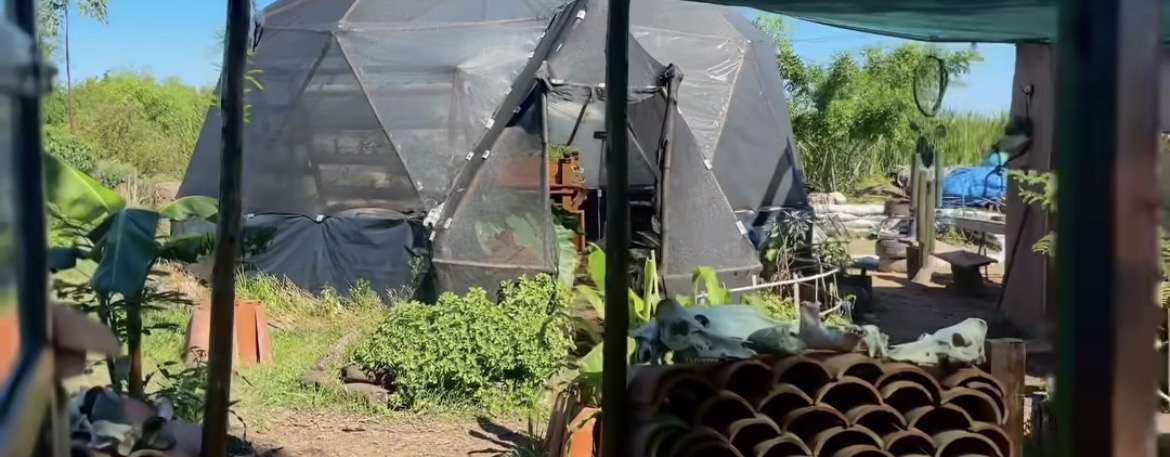
SAR (systemic aquaponic recirculation) system developed with ICCTI funding. Closed-loop plant multiplication using LECA substrate. Multiple bioconstruction techniques (COB, cob, bahareque, geodesic dome, encofrado) demonstrated with manual tools. Forest garden systems designed for biodiversity. Technology prioritizes accessibility and replicability over sophistication.
Open-access space (150-200 visitors). Free learning ("money not needed"). Seed bank creates commons knowledge. Demonstrates small-scale accessibility. Dignifies manual labor. Community skill-building. Two-person operation limits capacity for extensive participation, but philosophical commitment is strong.
UNNE (university): Architecture designing Forest Labyrinth; graphic design created branding; entrepreneurship speakers. ICCTI: Aquaponic innovation funding. Secretariat of Forest Development: seed partnerships. Secretariat of Territorial Development: machinery loans. Municipality: urban pruning waste supply (critical resource). Government role: technical accompaniment and institutional integration.
University students co-design real projects. Municipality supplies resources. Community participates in learning and seed exchange. Citizens access products directly at farm.
Located 4km from airport in peri-urban Resistencia, creating bridge between city and countryside. Responds to specific Chaco context (extreme climate, inundable soil, local identity). Connected to local networks and potential regional/international replication. Model designed for peri-urban Latin America.
Visitors learn agroforestry, bioconstruction, animal husbandry, fermentation, seed exchange. Flagship Forest Labyrinth integrating design and pedagogy. Philosophy: "Agricultural education for people to work earth again." Art-food-ecology integration emerging.
UNNE students engaged in real projects. Intergenerational knowledge integration (founders' heritage + contemporary methods). Project designed for long-term stewardship. Youth leadership roles not formalized.
Personal savings + government production ministry loan (primary support after crisis). Severe economic losses year one (300mm flooding). Resources allocated to production survival. Limited public funds despite institutional partnerships. Refinancing challenges ongoing. Sustainability timeline: 3.4 years proposed (specific projections: ➜ need confirmation).