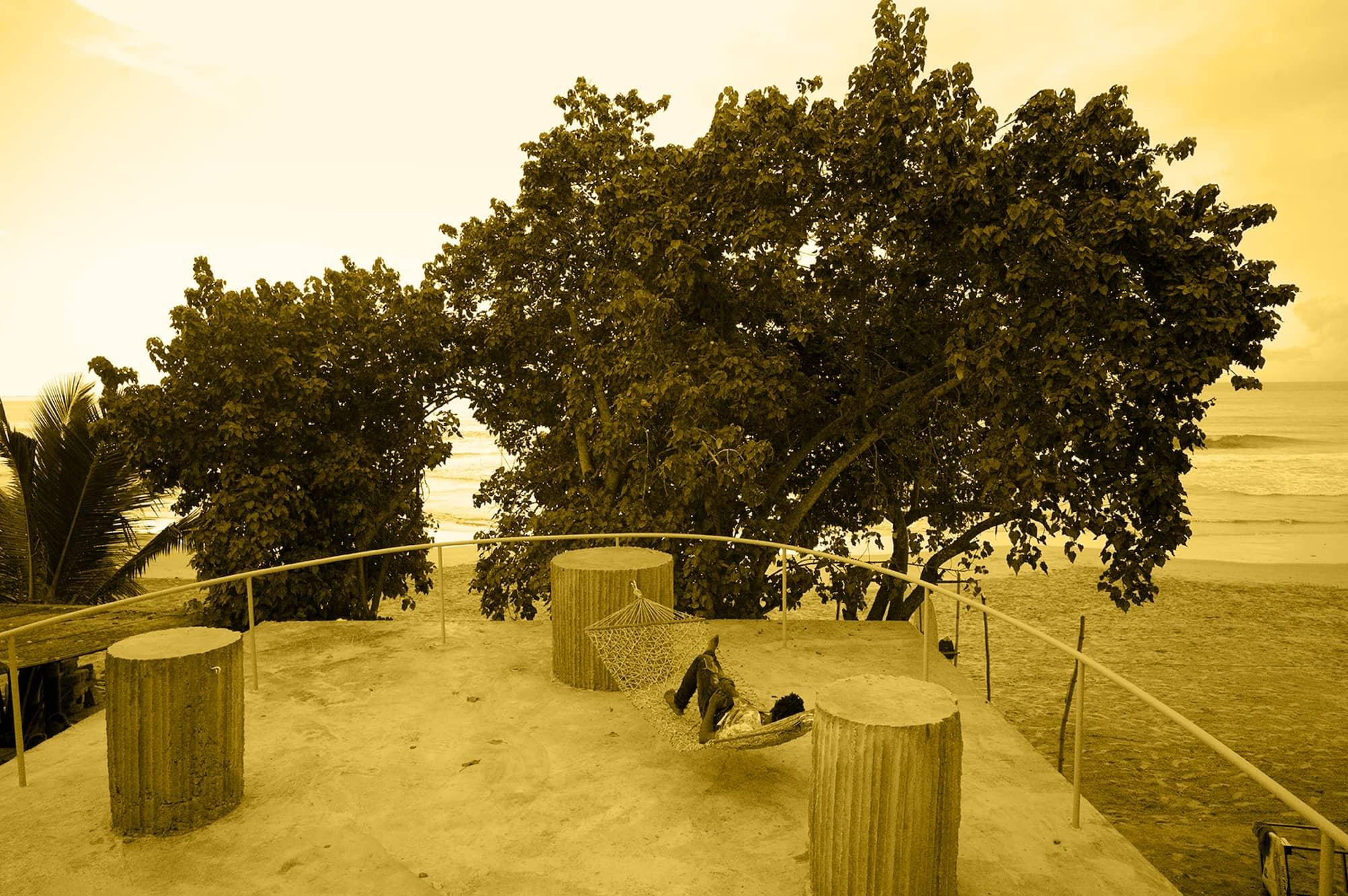
A community-run surf house and cultural hub in Busua that pools shared infrastructure (Wi-Fi, workstations, facilities, equipment, learning spaces) to bridge the digital gap, create safe youth spaces, and build skills and livelihoods through surfing, creative/digital workshops, and slow-tourism cross-subsidisation.
Surf House Ghana Collective in Busua (Western Region, Ghana) is a community-run surf house and shared socio-technical hub developed within the Surf Ghana ecosystem (founded 2017; Surf House initiated 2022). It responds to a local mismatch where tourism-driven growth benefits external operators more than residents, alongside limited safe youth spaces and high-cost internet access. The project pools shared resources—fast Wi-Fi and workstations, toilets and showers, surfboards and sports equipment, a small library, communal kitchen, and flexible spaces for workshops/events—and manages access through a commons-oriented, cross-subsidisation logic (visitor passes/partnerships help keep core services free or affordable for local youth). Activities include a structured daily surf club, creative and digital workshops (photography, filmmaking, music/DJ, digital storytelling), community-led cultural events, and mentoring pathways that enable youth to become athletes, coaches, creatives, and entrepreneurs. Governance is practice-based, with responsibilities shared among locals, strong daily coordination by the local manager and team, and continuous dialogue with youth and the community to co-create activities (weekly planning and annual budgeting/partnership review). Funding relies mainly on private sponsorships (notably Vans and On for the construction of the surf house and scholarships for locals, respectively), with earned income streams from a solidarity-based economic model (Wi-Fi services, homestays, merchandise), and limited support from foreign public bodies for specific exposure activities.
Surf House Ghana Collective in Busua emerged in response to structural local challenges: limited safe youth spaces, expensive and unstable internet access, and tourism benefits largely captured by external actors rather than residents. Established as an experiment within the broader Surf Ghana ecosystem (founded in 2017), the Surf House (initiated in 2022) was designed as a shared socio-technical infrastructure rather than a conventional surf lodge. The project pools physical, digital, and cultural resources: high-speed Wi-Fi and shared workstations; toilets and showers; surfboards and sports equipment; a small library; communal kitchen; and flexible spaces for workshops and events. These resources are made accessible to local youth either free or at reduced cost, supported by a cross-subsidisation model in which visitors, brand partnerships, and earned revenues help sustain community access. Core activities include daily surf club training, structured mentorship pathways, digital and creative workshops (photography, filmmaking, music/DJ, storytelling), and community-led cultural events. Youth participants progressively take on responsibilities such as assistant coaching, event coordination, and equipment stewardship. Governance combines structured daily management with participatory planning cycles and ongoing dialogue with community members and elders. As a result, the Surf House functions as a youth commons: it provides safe after-school engagement, reduces digital exclusion, builds cognitive and entrepreneurial skills, and enables pathways into livelihoods (coaching, creative industries, tourism-related roles). The initiative also contributes to reshaping local tourism toward a slower, more locally embedded model that reinvests value into the community.
Number and stability of local jobs created; Youth transitioning into paid roles (coach, assistant, creative services); Revenue streams (earned income + sponsorship); Local economic retention through cross-subsidisation; Contribution to the local tourism ecosystem; Reinvestment in equipment and infrastructure.
Private sponsorships (e.g., Vans construction support); Brand partnerships (e.g., On, FAT); Earned income streams (Wi-Fi access, homestays, merchandise, surf lessons); Local management and coaching labor; Volunteer and youth engagement; Physical infrastructure (Surf House building and equipment)
Provision of paid surf lessons and visitor services; Management of digital access services (Wi-Fi workspace); Hosting events and workshops; Mentorship and progressive role assignment (assistant coaches, creative contributors); Partnership management and sponsorship coordination; Reinvestment into maintenance and equipment.
Operational surf house with daily programming; Paid managerial and coaching roles; Youth engaged in income-generating pathways; Revenue generated from tourism-linked activities; Active brand and institutional partnerships; Continued maintenance and upgrading of shared infrastructure.
Stable employment for key local staff (manager, coaches); Emerging livelihood pathways for youth (sport, digital, creative, tourism-related services); Moderate local economic circulation through community-embedded tourism; Reduced dependency on external operators capturing tourism value; Partial but not fully diversified financial resilience (seasonality remains a factor).
Creation of stable employment for specific target groups (local youth and community members), with fair role progression and moderate but sustained contribution to local economic activity in Busua. The initiative strengthens local economic retention through a cross-subsidised tourism model but does not yet operate at scale sufficient to transform the broader labor market structure.
Local beach conditions and cleanliness; Environmental awareness among youth; Presence or absence of structured environmental stewardship activities; Impact of tourism-related activity on the coastal ecosystem.
Use of coastal space for surf activities; Youth engagement in beach-based programs, Informal norms of respect for shared spaces; Limited infrastructure footprint relative to mass tourism models.
Regular surf training and community presence on the beach; Informal reinforcement of environmental respect norms; Occasional beach care behaviors linked to stewardship culture (not formalized restoration).
Continued use of coastal area without evidence of environmental degradation directly attributable to the project; Youth exposure to ocean-based sport fostering environmental awareness; Absence of intensive extractive or polluting activities within project scope.
Maintenance of existing ecosystem conditions in the immediate area of activity; Slight improvement in environmental awareness among participating youth; No documented measurable ecological restoration outcomes.
The project maintains coastal ecosystem conditions and promotes informal environmental awareness through sustained presence and stewardship culture. However, it does not implement structured ecological restoration or regeneration programs and therefore does not demonstrate measurable recovery in ecosystem parameters.
Energy source of Surf House operations; Transport patterns related to project activities; Presence or absence of renewable energy systems; Waste management practices; Evidence of measured emissions reduction.
Small-scale physical infrastructure; Brand-sponsored construction materials; Local operational management; Tourism-linked visitor presence; Beach-based programming.
Daily surf programming; Workspace/Wi-Fi services; Hosting visitors and workshops; Maintenance of shared infrastructure.
Operational shared space with limited physical footprint; Localised tourism model embedded in community; No documented renewable energy or emissions-reduction systems implemented.
Environmental footprint likely lower than large-scale resort tourism models due to small scale and local embedding; No measurable reduction in emissions from baseline documented; No structured climate mitigation strategy.
The surf house operates at small scale and does not demonstrate measurable or documented emissions reduction. While its community-based model may indirectly reduce the higher environmental footprint associated with mass tourism, there is no evidence of structured climate-mitigation interventions or quantifiable reductions in greenhouse gas emissions.
Presence of technological innovation; Adoption or diffusion beyond internal use; Replication or transfer to external actors; Digital or technical infrastructure development; Scalability of innovation model.
Basic hospitality and recreational infrastructure; Surf equipment and shared facilities; Informal knowledge-sharing practices; Digital communication tools for coordination (standard use)
Operation of shared surf infrastructure; Knowledge exchange within the community; Internal organizational practices; Utilization of digital infrastructure (wifi) for content creation etc..
Output: Community hub for surf culture; Localized organizational innovation;
Strengthened local social infrastructure; Localized innovation in community-based surf ecosystem;
The initiative represents a social and cultural innovation rather than a technological one. There is no documented evidence of technological diffusion, formal adoption by external actors, or system-level innovation scaling.
Access to recreational and cultural resources; Inclusion of local youth; Reduction of social exclusion; Community participation in shared space governance; Equity in access to facilities.
Community-based shared surf space; Open access model; Local youth engagement; Informal mentorship and peer learning; Shared use of equipment and infrastructure.
Provision of access to surf lessons and equipment; Community events fostering social cohesion; Informal inclusion of local residents in surf culture; Creation of an accessible gathering space.
Local youth participation in surfing activities; Strengthened sense of belonging; Reduced symbolic barriers to participation in surf culture; Increased cross-cultural interaction between locals and visitors.
Expanded access to recreational and cultural resources for local youth; Strengthened local identity and agency within surf ecosystem; Improved social cohesion at small scale; Reduction of informal access gaps within the immediate community.
The initiative contributes to localized improvements in young people's access to cultural and recreational opportunities in Busua. It reduces symbolic and practical access barriers to surf culture and creates an inclusive shared space. However, the effects remain at the community level and are not institutionalized as structural redistribution of rights or systemic equity reform.
Type of employment contracts; Compliance with minimum wage standards; Working hours and safety conditions; Presence of social protection; Stability of employment; Adherence to fair labor practices.
Small-scale tourism and recreation operation; Local instructors and support roles; Community-driven organizational structure; Limited administrative formalization.
Provision of paid roles related to surf instruction and hospitality; Engagement of local workers in operational activities; Informal coordination and management practices.
Creation of localized employment opportunities; Income-generating roles for certain individuals; Operational continuity of small-scale workforce.
Basic employment opportunities generated; No documented evidence of formalized labor protections beyond baseline legal context; Employment appears stable at a small scale but without formalized international labor compliance structures.
The initiative provides localized employment and income opportunities, contributing modestly to livelihoods. However, there is no documented evidence of structured compliance with international labor standards, formalized social protection systems, or long-term contractual stability mechanisms.
Existence (and regularity) of governance routines, Existence of operational rule-setting mechanisms, Nature/degree of external institutional recognition, Evidence of formalization and organizational evolution.
Private sponsorship and partnerships funding infrastructure and operations. Human resources and leadership capacity. Legitimacy inputs from community institutions. Operational sustainability inputs.
Weekly coordination meetings to define priorities; annual report moment to review, exchange, and set budget/partnerships (esp. local partnerships). Ongoing negotiation/management of external partnerships and authorizations (embassies, ministries, sponsors), translating these into culturally appropriate daily operations. Implementation of practical governance tools (membership bundles; tailored local pricing; visitor passes) to balance openness, sustainability, and fairness.
Documented annual plan/report + budget and partnership priorities agreed for the year. Operational access regime in place (tiered membership/pricing; managed access rules) enabling day-to-day functioning of the commons-like hub. Active collaboration portfolio (sponsors/partners; linkages to schools via teacher partnership; authorized/acknowledged by relevant public actors).
Increased institutional consolidation and resilience of the project model (from NGO roots toward a more sustainable social-enterprise logic; stable routines and role clarity). Strengthened legitimacy and “enabling environment” through approvals/recognition (elders/chiefs; ministries/embassies), even without robust long-term domestic public co-production.
Durable local governance capacity for a shared socio-technical asset (Surf House as community infrastructure) that can persist beyond ad hoc charity/funding cycles, anchored in routine-based accountability and locally embedded leadership.
Breadth of stakeholder inclusion in design/operations Depth of participation Frequency of participatory moments Evidence of community legitimacy mechanisms Equity within participation
Local youth time/skills and volunteerism (youth participation; volunteering; stewardship roles). Community-based knowledge and legitimacy inputs (elders/chiefs/parents; local relationships built through long-term listening). Bridging actors enabling participation (teacher partnership for school surf/skate; coach/federation links; manager facilitating daily engagement).
Co-design and continuous dialogue on programming and needs (frequent conversations/meetings; feedback on what is working; annual plans for the surf station). Role-based participation: youth acting as coaches, organizers, filmmakers/content creators, equipment caretakers; day-to-day interactions with manager. Multi-stakeholder relationship work (dialogue with elders/ministries; community inclusion in management; increasing municipal/elder participation).
Concrete co-produced programs (surf club structure; workshops; events) shaped through feedback and ongoing interaction. A functioning stakeholder ecosystem around the hub (youth volunteers + staff roles + community approvals + partner linkages).
Measurable strengthening of participation quality: youth shift from “participants” to “stewards,” with enhanced skills, responsibility, and ownership of activities and shared assets. Growing community buy-in and legitimacy over time (elders’ support; increased municipal/elder participation; project framed as for the whole community).
Institutionalized, commons-like participation: sustained power-sharing in day-to-day governance and program production, generating durable local capability (leadership pathways, volunteer-to-job transitions, and long-term community anchoring of the space).
Diversity of local groups engaged. Frequency/regularity of community use and interaction. Local legitimacy/acceptance (elders/chiefs approval; growing municipal/elder involvement over time). Place-based identity and social cohesion signals. Local economic embeddedness (re-embedding tourism benefits locally; jobs created; local opportunity pathways).
Long-term presence and ethnographic listening across local actors (youth, schoolteachers, elders, parents, restaurant owners, surfers, travelers). Community legitimacy/approval infrastructure (elders/chiefs support; “in Africa… they look for approval”; community backing). Shared physical hub on Busua Beach + basic amenities (toilets/showers, flexible spaces) that make the site usable as a community node. Cross-subsidised financing tied to slow tourism and partnerships (visitor spend + sponsorship + earned income supporting local access).
Co-designed programming through ongoing dialogue, meetings, annual planning/feedback routines with local youth/community. Running the Surf House as an everyday “third place” for Busua youth: study, socialising, planning, workshops, and events. Partnerships that connect the initiative to local institutions (e.g., teacher/school linkage for surf/skate activities; increasing municipal/elder participation).
Operational community hub offering shared space + connectivity + amenities used by local youth and community. Regular structured activities (daily surf club; creative workshops; community-led events). Tangible local roles and volunteering/participation in operations (youth helping manage equipment/events; local leadership roles emerging).
Regular involvement of community members with moderate-to-high trust and dialogue, evidenced by sustained engagement and increasing elder/municipal involvement. Strengthened place-based identity and community pride in Busua; reduced push factors for youth out-migration. Tourism value re-embedded into local benefit pathways (skills, networks, local opportunity) rather than extractive visitor-only gains.
Wider local cohesion around a shared community asset (“place where they grow the community”), with durable legitimacy rooted in elders/community approval and ongoing use. Local development effects through job creation and new local professions/industry pathways (e.g., surf coach/manager; certifications; federation-building), with spillovers to other coastal communities (replication noted).
Number and frequency of learning activities (surf training, skate, creative workshops, community events). Diversity of participants (local youth, girls and boys, volunteers, visiting surfers). Skills development pathways (e.g., surf coaching certification, leadership roles). Continuity of programming (daily/regular club structure rather than one-off events).
Experienced surf instructors and peer mentors. Physical learning space (Surf House as safe hub). Equipment (boards, skate materials, training gear). Partnerships (e.g., schools/teachers, local leaders, sponsors). Community knowledge and local cultural context.
Daily surf club and structured training sessions. Skill-building workshops (sport, creativity, entrepreneurship, leadership). Informal mentoring and peer learning. Exposure to global surf culture integrated with local identity.
Regular training sessions delivered. Youth acquiring surf, leadership, and organizational skills. Community-led events hosted at the Surf House. Emergence of certified local surf coaches.
Increased confidence, discipline, and teamwork among youth. New career pathways in surf, tourism, and creative sectors. Stronger cultural identity around Busua’s surf scene. Ongoing, structured learning embedded in daily life.
Sustainable, community-rooted educational ecosystem linked to sport and culture. Long-term empowerment of youth through transferable skills and global networks. Cultural regeneration: surf becomes both a livelihood pathway and a shared community narrative.
Proportion of youth participating in daily activities. Presence of youth in mentoring or assistant coach roles. Evidence of skills transition into employment (surf coach, tourism, creative work). Long-term vision focused on youth empowerment and leadership.
Youth-centered vision and mission. Local young surfers and trainees. Mentors and senior surfers transferring skills. Safe physical space for youth engagement (Surf House). Equipment and sponsorship support.
Daily youth surf training and mentorship. Leadership development (assistant coaching, event organization). Exposure to international surf networks and opportunities. Peer-to-peer learning and role modelling.
Youth trained in surf, safety, teamwork, and discipline. Emergence of young local surf instructors. Increased youth participation in community events.
Clear livelihood pathways for young people in surf tourism. Strengthened youth confidence and leadership capacity. Reduced vulnerability through structured engagement and skills acquisition.
Intergenerational transfer of knowledge within Busua’s surf ecosystem. Long-term youth empowerment embedded in local development. Surf culture institutionalized as a sustainable youth-driven economic sector.
Multiple revenue streams (surf lessons, accommodation, tourism services). Presence of sponsorships and brand partnerships. Operational costs covered through recurring income. Evidence of reinvestment into equipment and youth training.
Founders’ initial capital and infrastructure (Surf House facility). Surf equipment and training materials. Brand sponsorships (e.g., surf/skate companies). Tourism demand in Busua.
Paid surf lessons and coaching services. Accommodation and hospitality services. Organization of surf events and partnerships. Reinvestment of revenue into training and operations.
Stable operational cash flow. Diversified income sources (training + tourism + partnerships). Local employment and paid coaching roles.
Financial sustainability of daily operations. Reduced dependence on single donors or grants. Ability to scale activities and maintain equipment.
Long-term economic anchor in Busua’s surf tourism ecosystem. Creation of local livelihoods linked to surf economy. Strengthened financial resilience of a community-based initiative.