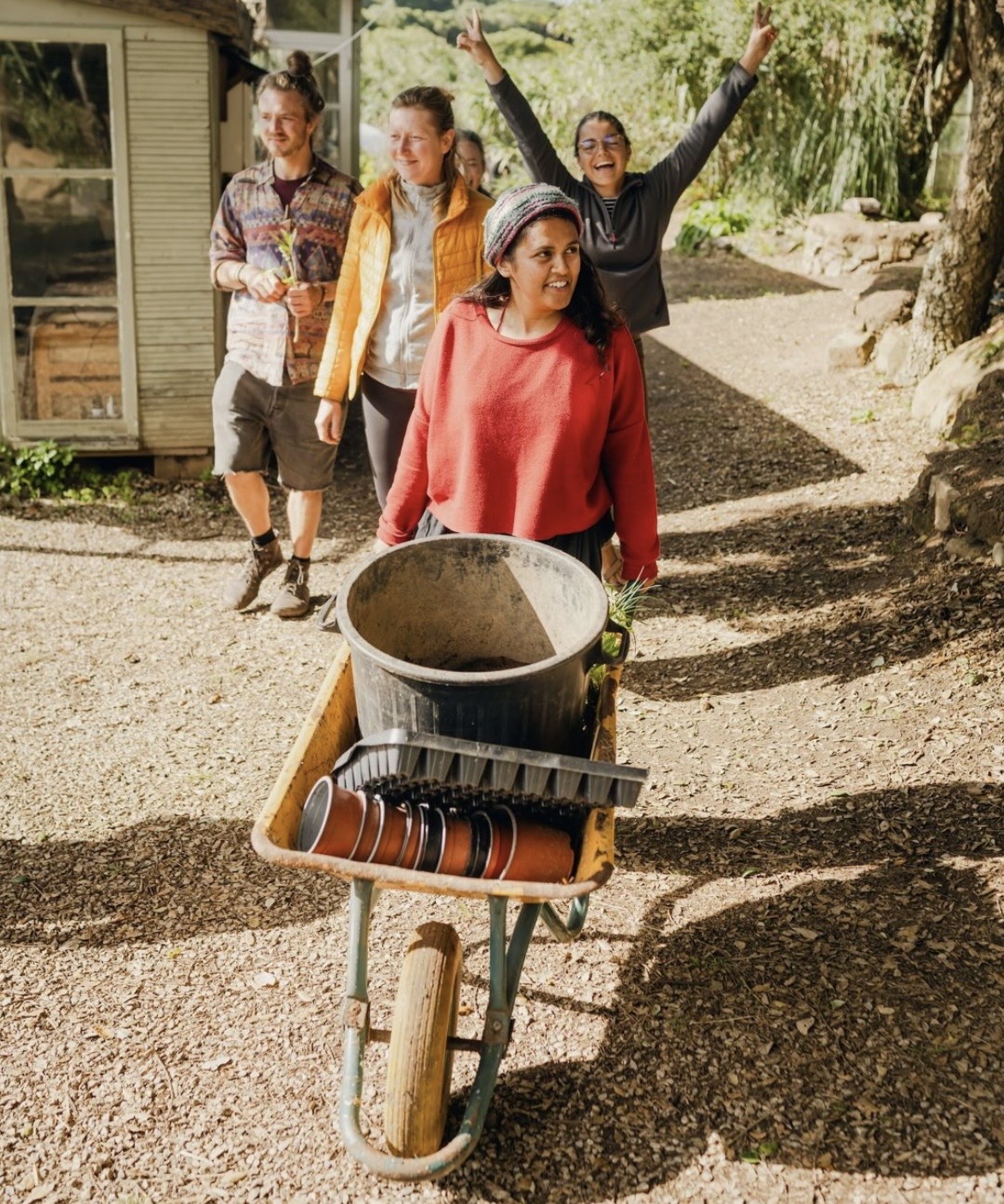
Terra Alta is a well-established permaculture and regenerative agriculture educational center located in the mountains of Sintra, near Lisbon, Portugal. The center provides earth-based education integrating permaculture design, forest gardening, natural building, bio-intensive market gardening, and social permaculture among other disciplines. Operating as a non-profit project run by a group of friends with shared vision, Terra Alta focuses on both individual growth and collective action. The center is adapted to local needs in food production, sharing of surplus, and inspiring people to connect with nature.
Terra Alta is a well-established permaculture and regenerative agriculture educational center located in the mountains of Sintra, near Lisbon, Portugal. The center provides earth-based education integrating permaculture design, forest gardening, natural building, bio-intensive market gardening, and social permaculture among other disciplines.
Operating as a non-profit project run by a group of friends with shared vision, Terra Alta focuses on both individual growth and collective action. The center is adapted to local needs in food production, sharing of surplus, and inspiring people to connect with nature.
Location: Sintra Mountains, near Lisbon, Portugal
Stage: Established (10+ years operation)
Mission: Earth-based education and cultural freedom integrated with ecological regeneration
Operating for 10+ years with demonstrated sustainability and impact. Mature organization with formalized educational programs, alumni network, and institutional presence. Not in growth phase but in maintenance and deepening phase.
Timeline:
10+ years: Sustained operation
Current: Established programs and relationships
Expected duration: “We expect to live a long life, depending on the upcoming generation of earth stewards”
Fully operational with established programs, alumni network, and community presence. Long-term commitment to place and practice. Not facing acute challenges (“We face no challenges rather than the one imposed by our current world leaders”).
Operational Status:
Established programs with alumni students
Connected to UK Permaculture Association and Escola Da Terra (Waldorf Education)
International network of alumni extending influence
Self-funded through personal investment and program revenue
Transparent, open communication and participatory decision systems
Terra Alta was founded on a conviction that earth-based education is not marginal but central to human flourishing and cultural freedom. In a world increasingly disconnected from land, seasons, and ecological cycles, Terra Alta offers an alternative: direct relationship with living systems as foundation for learning and meaning-making.
The project emerged from a group of friends sharing this vision and committing to making it real on a piece of land in Sintra's mountains. Not as commercial enterprise, but as shared commitment to earth-based education and regeneration.
THE PRACTICE: PERMACULTURE AS PEDAGOGY
Terra Alta teaches permaculture not as set of techniques but as holistic design system encompassing:
Forest Gardening: Designing productive systems that mimic forest ecology—diverse, resilient, regenerative
Natural Building: Creating shelter using local materials and traditional/contemporary techniques that respect ecological limits
Bio-Intensive Market Gardening: Growing abundance on small land through careful design and intensive practice
Social Permaculture: Applying permaculture design principles to human relationships, organizations, communities
Each element teaches ecological literacy—how to read and work with living systems, understand relationships, design for resilience.
THE COMMITMENT: 10+ YEARS
The commitment to continue "expecting to live a long life, depending on the upcoming generation of earth stewards" reflects long-term thinking uncommon in contemporary projects. No exit strategy, no growth exit—rather, intergenerational stewardship.
This longevity allows:
Deep land knowledge accumulation
Educational maturation and refinement
Alumni network development and influence
Integration into local and regional systems
Modeling of sustainable practice over time
THE REACH: ALUMNI NETWORK AND INFLUENCE
While Terra Alta operates a single site, its reach extends through:
Alumni Students: International participants who carry learning back to their contexts
Partnerships: Connection to UK Permaculture Association and Escola Da Terra (Waldorf Education tradition)
Network: Part of broader European permaculture and earth-based education movement
Cultural Influence: Participants becoming agents of change in their home contexts
One student educated at Terra Alta can influence dozens or hundreds in their subsequent practice.
THE CHALLENGE: GOVERNMENT ISOLATION
Terra Alta explicitly states: "Unfortunately very little or none" regarding government support or collaboration. This raises questions:
Is this deliberate? Choosing independence from state structures?
Is this circumstantial? Limited government engagement with permaculture education?
Is this strategic? Maintaining educational autonomy from institutional oversight?
The questionnaire does not clarify, but the isolation is noteworthy given other projects' emphasis on institutional integration.
THE SUSTAINABILITY MODEL: PERSONAL INVESTMENT + EARNED REVENUE
Unlike projects seeking grants or public funding, Terra Alta:
Funded through personal investment from founding group
Sustained through revenue from educational programs (workshops, courses, residencies)
No public funds involved
Self-directed in mission and practice
Independent from institutional oversight
This model provides autonomy but also vulnerability—entirely dependent on private resources and earned income.
THE FUTURE: GENERATIONAL VISION
The explicit mention of "upcoming generation of earth stewards" indicates generational thinking. The hope is not to maintain Terra Alta as fixed entity but to develop capacity in participants to continue and evolve earth-based work across contexts.
THE SIGNIFICANCE: PEDAGOGY OF PLACE
Terra Alta demonstrates that:
Earth-based education is viable long-term
It can be self-sustaining without government support
It generates alumni network influence
Connection to place deepens over years
Ecological regeneration and education are inseparable
Personal investment + earned revenue from programs sustains operations. No external grants or public funding. Financially stable but not growth-oriented. Model appropriate to scale and mission.
Land shows evidence of ecological restoration and careful management. Forest gardening, natural building, and regenerative agriculture demonstrate principles. Environmental impact extends through alumni network practice and teaching.
Uses Canva, Premier, AI tools, farming apps. Digital tools facilitate presentation/management but secondary to hands-on practice. No sophisticated digital infrastructure.
Transparent communication, participatory decision-making. Focus on individual growth and collective action. Educational accessibility through courses and workshops. Contribution to social justice through environmental regeneration and ecological literacy.
Operated independently from government structures. Very little formal support or recognition. Not integrated with public institutions. Independent nonprofit model with no institutional backing.
Connected to UK Permaculture Association and Escola Da Terra (Waldorf Education). Partnerships are informal and knowledge-based rather than operational.
Located in Sintra mountains, adapted to local context. Regional influence through educational programs and alumni networks. Long-term commitment to place.
Core mission: earth-based education and cultural freedom. Teaches forest gardening, natural building, bio-intensive market gardens, social permaculture. Educational activities continuous through workshops and residencies. Alumni network extends learning.
Explicitly addresses future generations ("upcoming generation of earth stewards"). Educational focus on youth. Succession planning implied but not detailed. Formal youth leadership roles not mentioned.
Personal investment + program revenue sustains operations. No external grants or public funding. Financially stable but not growth-oriented. Model appropriate to scale and mission.